Presidential Culture Award
A national award ceremony runs once, live, with the President in the room. The screen behind it is a folded wall seven and a half times wider than it is tall — and for almost the whole evening, somebody is standing in front of it.

- All of the screen motion for the evening
- The key-visual reveal
- The award presentation films
- The visuals for the halftime performance, both acts
- The key visual, supplied by the host's designer
- Ceremony direction and production
- Choreography and performance
- Stage build, lighting and LED hardware
- Live camera and broadcast
- Culture Cultivation — Ju Ming
- Humanitarian Dedication — Mennonite Christian Hospital's Liming Institution
- Youth Creativity — LuxuryLogico
- Local Hope — Fang Ho-Sheng
- Social Reform — Taiwan Association for Human Rights
- Presented by Vice President Chen Chien-jen, with President Tsai Ing-wen in attendance.
- The Double Theatre — 複象公場
- My Skin Against Your Skin — 激膚
- The performance is theirs. The screen behind it is mine.
Seven and a half to one, with someone in front of it
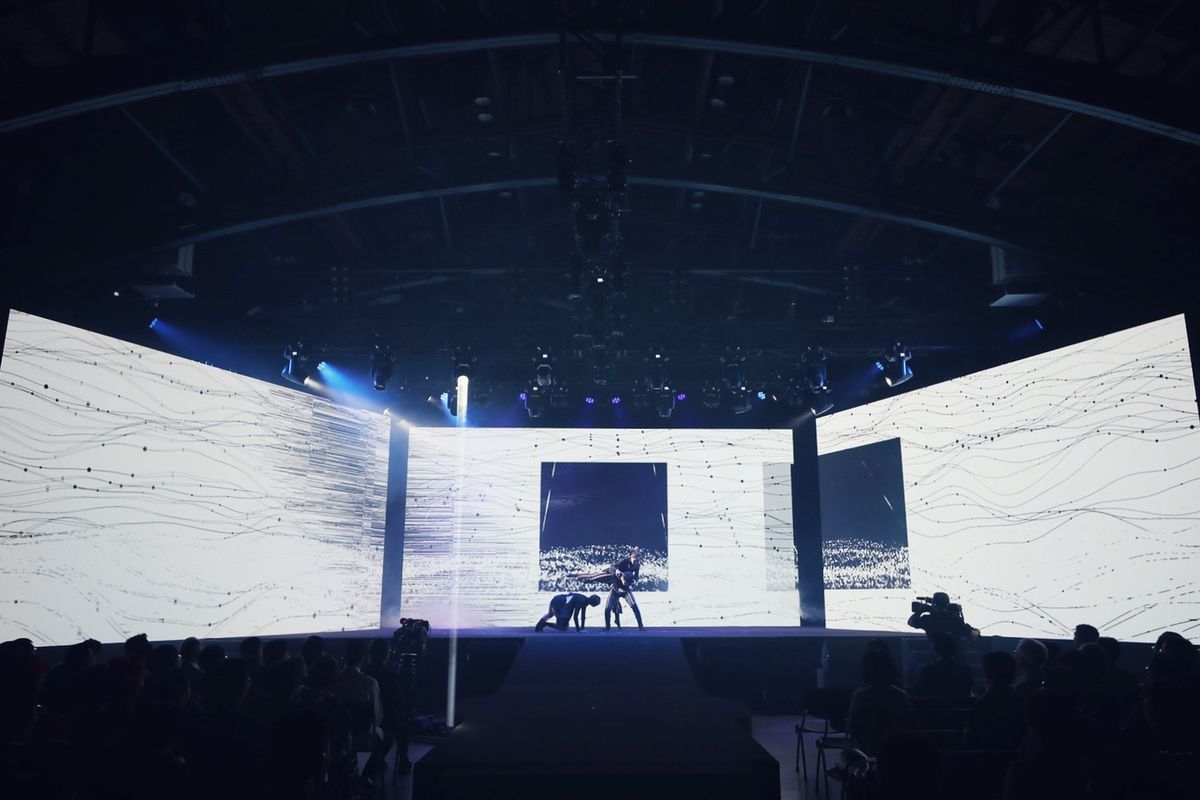
The delivered files are 3840 × 512, and some of them 3072 × 512. At that ratio nothing can be composed the way a frame is composed. There is no middle to put something in the middle of — the wall is long enough that the two ends are separate events, and it folds, so a shape crossing a seam arrives bent for most of the room.
The harder constraint is that the centre is never empty. A host stands there. Then a winner. Then five people from an organisation, in a line. Then two dancers. The centre of the canvas is not a place to put anything; it is the thing everything else has to work around.
So the weight goes to the wings. Calligraphy is set large enough to land on the angled planes, where it reads from a seat at either end of the hall, and the centre keeps only what survives a person in front of it: the seal, the award's name, and the mark.

One visual, five characters
What arrived from the host was a key visual: tan folded planes, a red seal, the words 文化自信 — cultural confidence — and NEXT 20, the tenth edition looking at the next twenty years. A printed thing, holding still.
It had to become an evening. Five awards, each needing its own character, none of them allowed to leave the system. What stayed fixed across all of them: the folded tan ribbon, the seal cut with 第十屆總統文化獎 in it, vertical type in a black or white panel, and NEXT 20 turned on its side. What changed was colour and behaviour.
Humanitarian Dedication is mint, with brush strokes drifting through it; nothing in it accelerates. Youth Creativity is magenta, violet and cyan in vertical bands that stutter and tear, and it is cut faster than anything else in the show. Social Reform is red and tan chevrons travelling the length of the wall in one direction, ruled lines running underneath them. It pushes.
Each film runs fifteen to twenty seconds, which is roughly how long it takes to walk from a seat to a podium.


The same system under three different treatments. The square recurs all evening — as a frame to stand inside, as the seal, and as the shape the wall falls back to when it has nothing to say.
Nine minutes, and the bodies have to read
The halftime performance runs nine minutes and has two acts, with a different company in each.
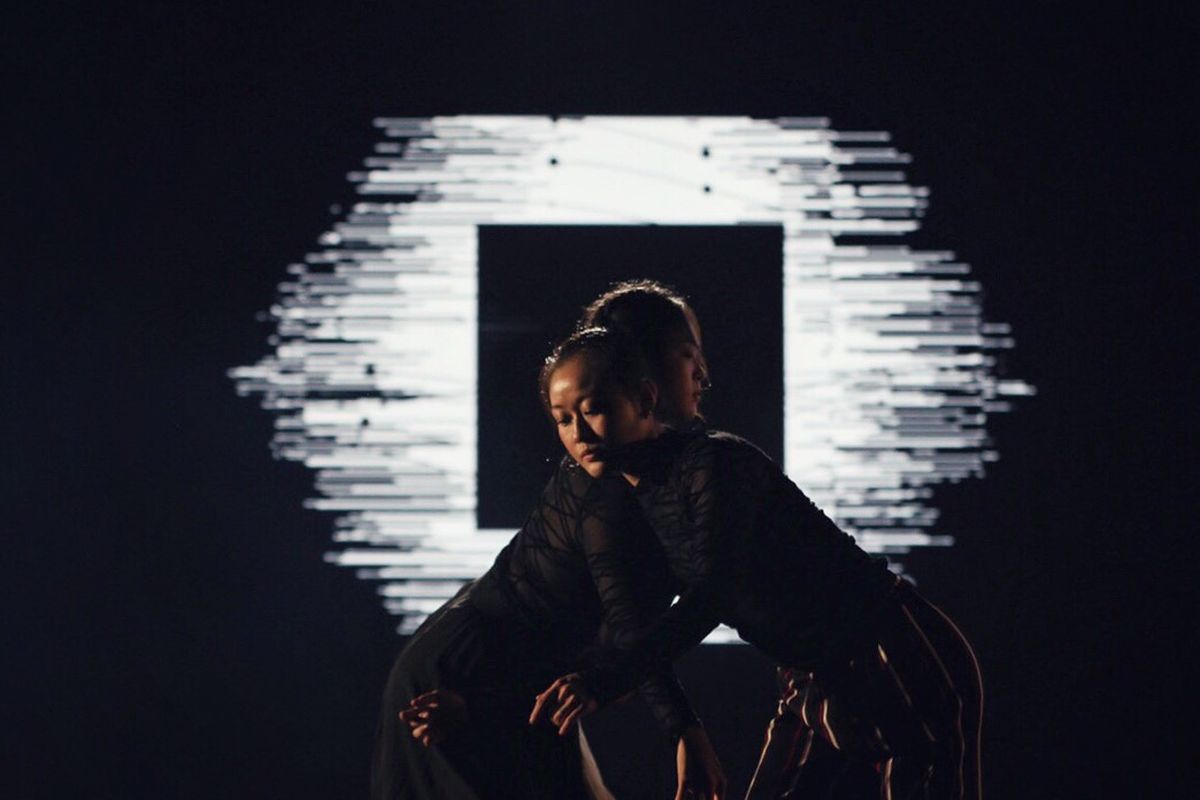
The first is The Double Theatre, and the wall stays monochrome for all of it. Wireframe cubes hang and turn, scan lines tear across, a field of particles builds into a ridge and settles.
Monochrome is not a taste decision here. The performers stand directly in front of the wall, so whatever the wall is doing is competing with their outline, and an image full of mid-tones swallows a body whole. Pushing the contrast to the ends — near-black against near-white, with very little in between — is what keeps a figure readable as a shape while a picture moves behind it.
The sequence is cut to the company's own music and rhythm rather than laid underneath it. The image takes the beats, holds where they hold, and moves when they move, so the wall is playing in the piece instead of sitting behind it.
The second act is My Skin Against Your Skin, and the wall turns over with them: an aerial city in red and white light, then saturated magenta and cyan with the lyric written by hand straight across the width.
The lyric is set twice — once left of centre, once right of centre. Nobody reads it twice. Everybody reads whichever one does not have a performer standing in front of it.

Sharing the wall with a camera
One more thing lives on that wall: the live camera feed. When a winner speaks, their face goes up at about a metre tall, inset into whatever graphic is already running.
That means the graphic cannot be a single composed image. It has to hold a hard-edged rectangle of video somewhere inside it without the rectangle looking like damage — so the layouts keep a block the video can land in, and the surrounding pattern is built to be interrupted.
