Future Laboratory
The last stop in the exhibition. A visitor answers nine questions about the future they want, is sent to one of three islands, designs and draws an object for it, then swipes it onto a projected world that everyone else in the building is also building.
- Visual design for the projected world and the interface
- UI design for the touch stations
- UX and the whole interaction flow, standby to send-off
- The values quiz and its weighted scoring, worked out with the PM and developers from the curatorial content
- Interactive content design: 27 objects, their functions and their drawable areas
- All 27 object models, their drawable regions and UV layout, and every asset and spec handed to the developers
- Integrating and adapting third-party environment assets into the scene
- The other three zones of the exhibition
- The exhibition identity, key visual and posters
- Curation and exhibition content
- Original modelling of the surrounding environment — trees and similar assets were sourced and adapted, not built from scratch
- Spatial design and exhibition build
- Software development
- Projection, hardware and calibration
- Project management
- Tronk Interactive, development
- Project manager
- Spatial design team
- Museum curators
- ADC 104th Annual Awards, Silver — Exhibition Design, Museum Exhibition. The only Taiwanese team to win in the category.
- MUSE Design Awards, Gold — Conceptual Design, Education
- MUSE Design Awards, Silver — Interior Design, Exhibits, Pavilions & Exhibitions
- Awarded to the exhibition as a whole.
The last room, and the only one that asks you a question
The exhibition runs across four zones on the sixth floor. The last of them, the Future Laboratory, is staged as a designer's home office: a desk, a sofa, work left half-finished. The future as somewhere you work, rather than a showroom you file past.
Visitors arrive as interns reaching the final test at the research centre. Three islands are still under development, each with its own values and its own unmet needs, and the intern is asked to help finish one. What the islands end up looking like is decided entirely by the people who walk through.
The piece is one projected wall and two touch stations. Everything below is what happens between them.


How do you get a stranger to commit to one version of the future, and then show them what everybody else chose?
Nine questions decide where you go
You are not given a choice of island. You are sorted into one.
Nine statements, answered on a ten-point agreement scale rather than yes or no, because the interesting answers are the lukewarm ones. Three statements belong to each island. The statement that defines an island most sharply is weighted triple; the other two count once. Highest total takes you. A tie is broken at random.
It matters that this reads as a values sort and not a score. There is no best island and no right answer, so nothing on screen ranks the three or congratulates you on where you landed.
- Innovation Island — technology as the way to a more convenient, abundant, balanced life
- Entertainment Island — the metaverse, sensory experience, play folded into daily life
- Conservation Island — species preservation and ecological recovery, buildings kept to a minimum

Twenty-seven objects, each with somewhere to draw
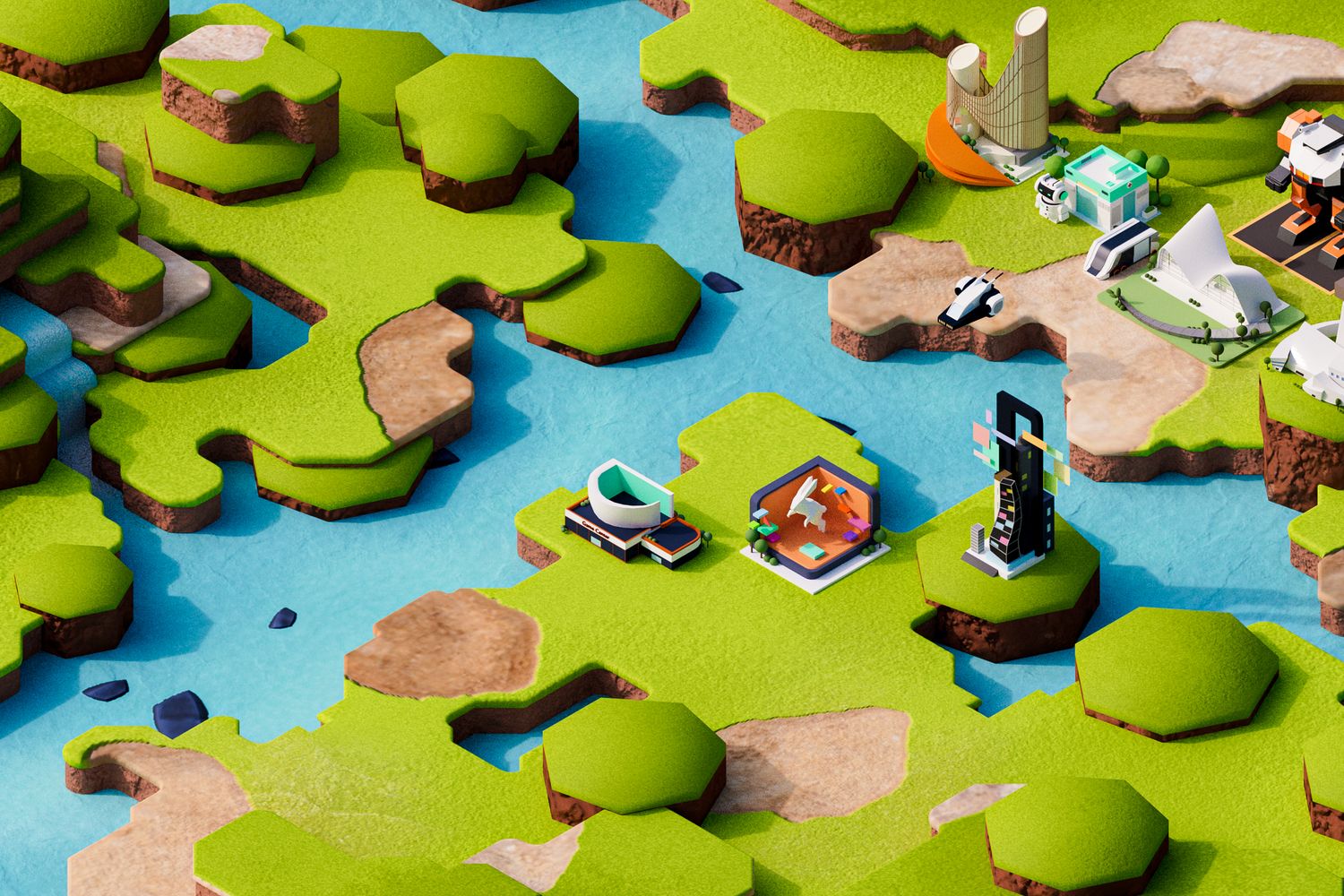
Each island offers three kinds of task, and each task has three possible functions. Innovation Island wants vehicles, robots and buildings; a building can be a tower, a shape-shifter or a green space. That grid gives nine objects per island, twenty-seven in total.
Every one was specified three ways: how it looks, how it behaves once it is standing on the island, and — the part that carries the whole piece — which part of it glows and can be drawn on.
I built all twenty-seven, from the first sketches through to the drawable region and UV layout of each one, then handed the models and specs to the developers to wire up. The surrounding environment is a mix: some of it mine, some sourced and adapted to match.
That drawable area was the real constraint. It has to read as somebody's own from across a dark room, at the size of a hexagonal tile, while the object still reads as a hospital robot or a seed vault rather than a smear. Too small and the drawing disappears; too large and the object stops being the thing it was supposed to teach.

Design it, then let it go
Drawing has no time limit. Colour, brush thickness, zoom and rotation are all on the panel, and the object turns slowly on a confirmation screen before it is sent, so nobody sends a drawing they did not mean.
Idle for thirty seconds and a dialog asks whether you are still designing, then counts down ten seconds before releasing the station. A public queue needs that; a visitor who wandered off should not hold a machine, and a visitor still thinking should not be thrown out.
Sending is a swipe up, off the bottom of the touch screen. The object leaves your hands, appears in the middle of the projected wall, and falls onto your island.
- StandbyThe wall keeps building without you
- Nine statementsAgreement, one to ten
- Get your islandWeighted, not chosen
- Pick a taskWhat the island still needs
- Give it a functionThree per object
- Draw on the glowNo time limit
- Swipe up to sendOff the screen, onto the wall
- Watch it landIt stays for the rest of the day


The wall is a reading of the room
The closing screen is generated from two things at once: the island you were sorted into, and the live distribution of objects across all three islands. It ranks the islands by how many people have contributed to each, and tells you where you sat relative to everyone else that day — the majority, or one of the few.
Two rules keep the wall from collapsing into one shape. If a single object type passes 70% of everything on an island, the next visitor is nudged toward a task that is under-served. And when an island runs out of land, the oldest objects are overwritten first, so the wall stays current rather than freezing at whatever the morning happened to want.
Everything clears at the end of each day. The wall is a portrait of the people who came through that day, and it is never the same portrait twice.

In the room
One wall, two stations, and a queue that never stops rearranging what is on it.

