Wufeng Lin Family Mansion
A hundred and thirty years of one Taiwanese family, on three walls and a floor that reflects them. The buildings in it are drawn, because nobody photographed 1788. The people are real, because somebody photographed 1921.
- The historical sequence of the immersive projection, from the opening through 1921
- Scene design, illustration and animation for it
- The remainder of the projection, after 1921
- Curation and historical research
- The rest of the exhibition
- Exhibition and spatial design
- Projection hardware, blending and calibration
- 王碩仁, 林經堯, 林素幸, 盧泰康
- Director of the exhibition, 詹景裕
- Tainan National University of the Arts, with Lin Pen Tang Co., the A-Tsao-Wu Culture Foundation, the Lin Hsien-tang Museum and the Wufeng Datun Culture Studio.
An island made of particles, and then 1788
The curatorial idea was island DNA — that every stretch of history is a sequence you cannot copy, and that the Lin family of Wufeng is one of the longest legible stretches Taiwan has. The exhibition took the title 走入霧風, walking into Wufeng's mist.
So the piece opens with the island itself, assembled out of drifting gold particles over a cold network of lines, held for a few seconds, and then let go. The particles fall, and what they fall into is a date: 1788, a thatched courtyard house under trees.
Ten dated cards follow, and they are not in order. The sequence runs the military line of the family first — 1854 and the war, 1864 and the plaque that gave the house its name, 1884 and the battle standards, 1888 and the camphor trade, 1894 and the banquet hall — and then goes back and picks up the other line, the one that put down its weapons and started a school: 1893, 1887, 1910, 1921.
Nothing in that is explained in the room. The dates do the explaining, and each one arrives with the building that belongs to it.
You cannot photograph 1788
That is the whole problem of the piece. Most of this history happened before anyone in Taiwan owned a camera, and the parts that were photographed were photographed badly, in small numbers, on paper that has since gone brown.
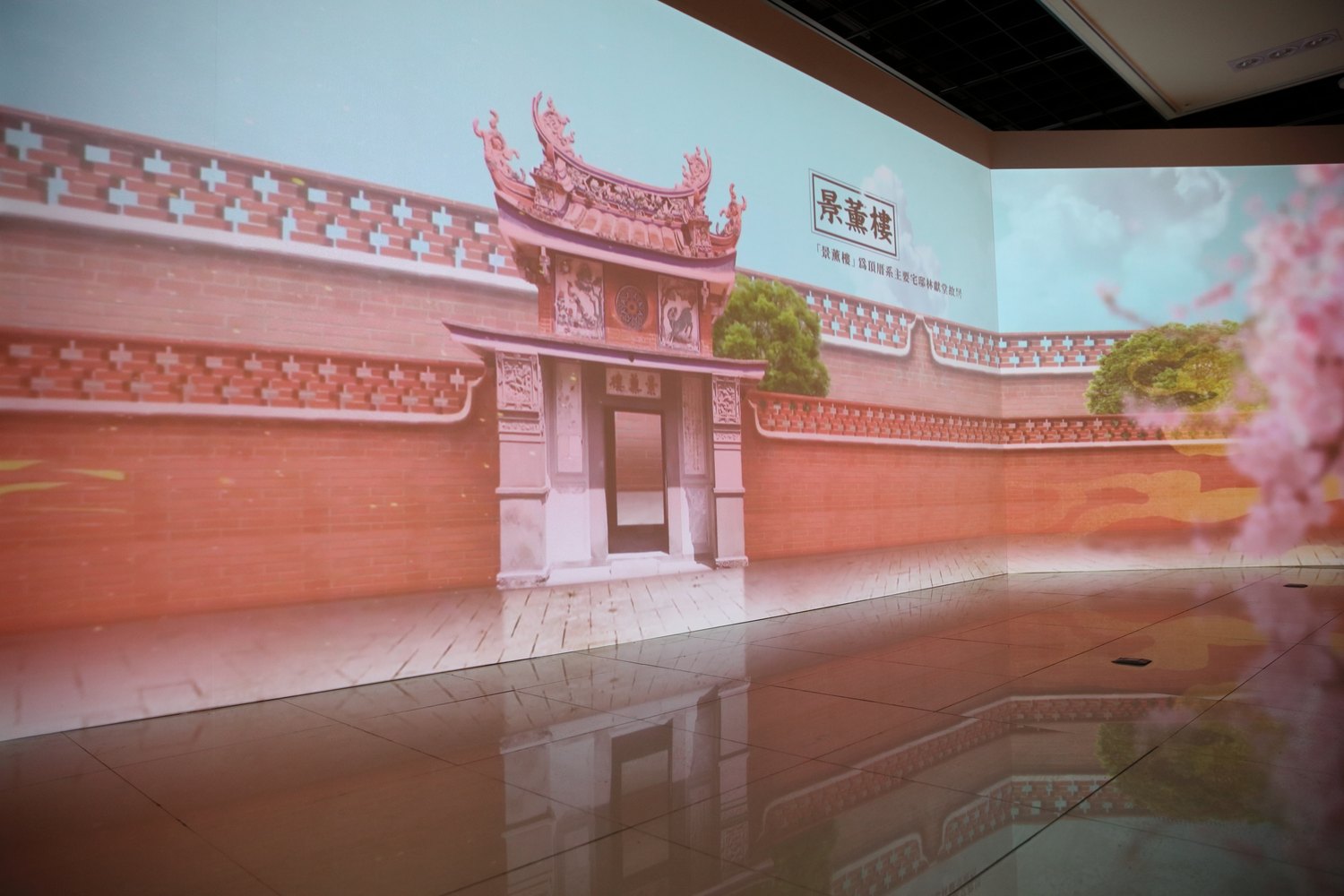
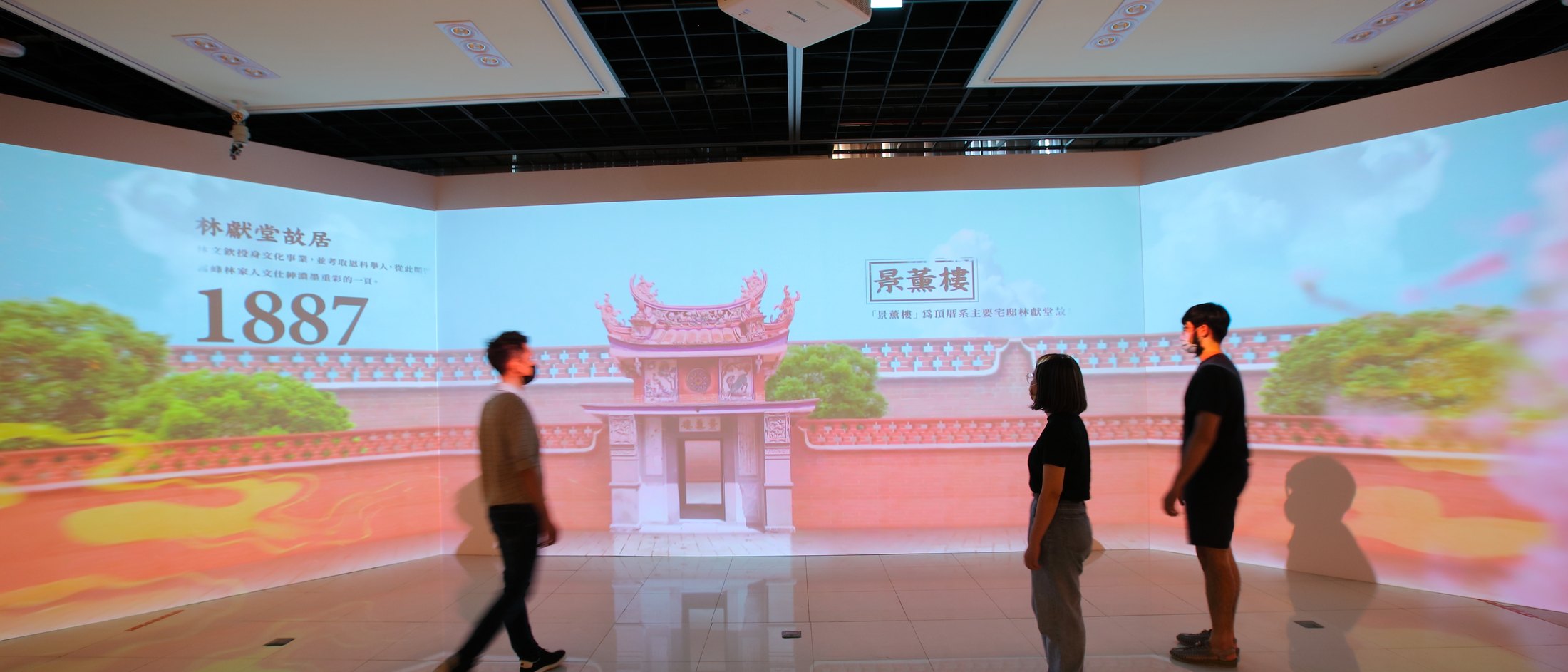
So the architecture is drawn — the courtyard walls, the roof ridges, the gates, the pavilion out over the water — and rendered in flat, deliberately unreal colour: mint skies, coral ground, ink-wash haze. It does not pretend to be a photograph, because a fake photograph of 1788 would be a lie that a visitor can feel.
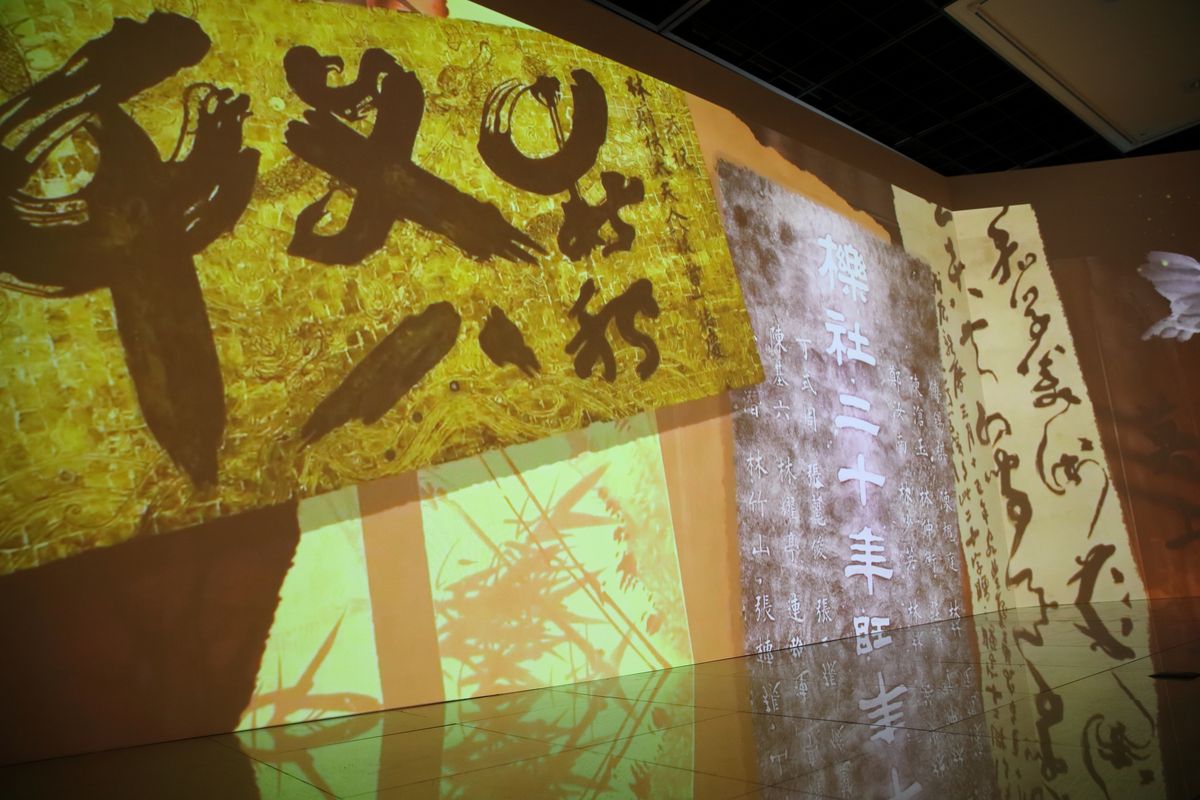
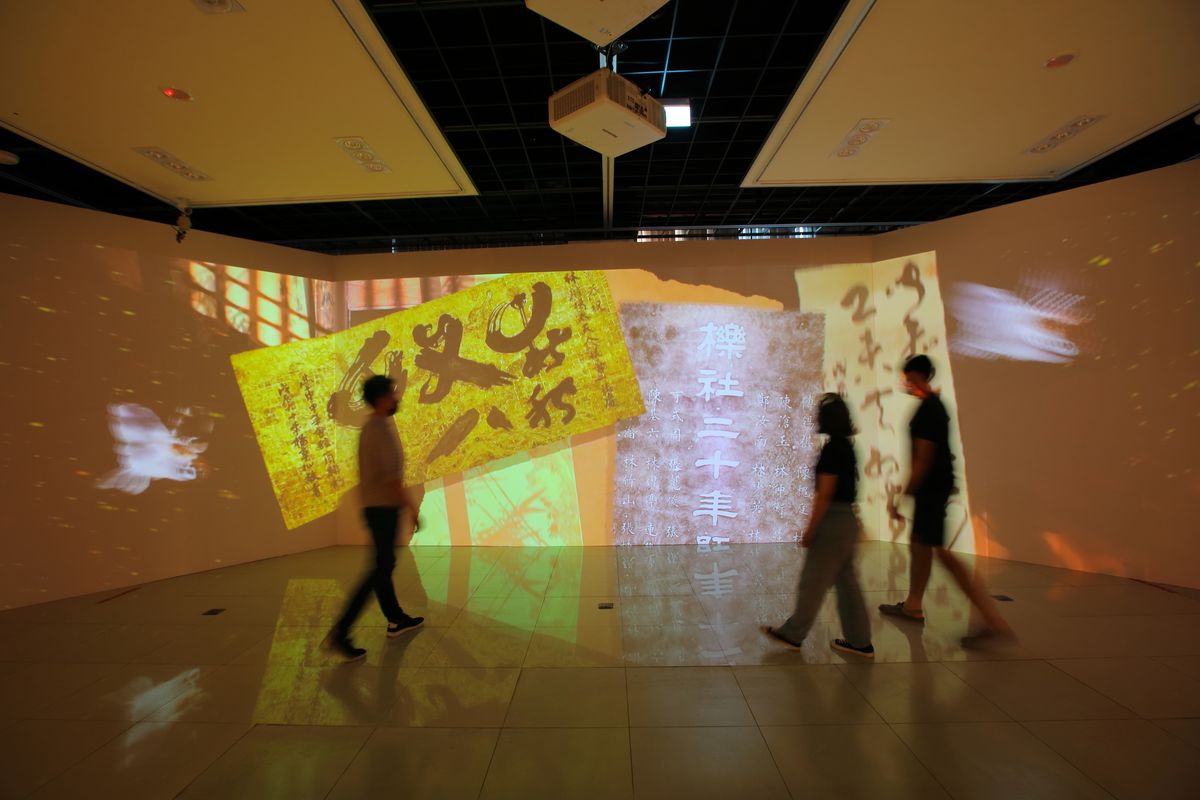
What is real is dropped into it. The 1921 founding photograph of the Taiwan Cultural Association sits in the middle of a drawn courtyard, with the real faces of the real people who were there. The plaque, the calligraphy, the printed poetry collections: all photographed objects, composited into painted rooms.
Holding those two registers together is a band of scan-line tearing that runs through the whole sequence — the texture of a damaged recording. It is not decoration. It gives the drawn material and the photographed material the same surface, so the join between them stops being the thing you look at.



Three walls, and a floor that reflects
The room is a wrap: a flat wall ahead and one down each side, meeting at two corners, with the projectors overhead. The floor is polished, which is not a thing the content can opt out of — whatever is on the walls is also on the floor, upside down, at about half strength.
That decides where the horizon goes. Put the ground line of a courtyard low in the frame and the floor picks it up and carries it toward the visitor's feet, and the painted courtyard reads as the room's own floor. Put it high and the reflection turns into a bright smear that competes with the wall.
It also sets the scale. The gate is drawn at roughly the height it would be, so somebody standing in front of it stands at the size they would be in the real courtyard at Wufeng — which is the one thing a photograph on a gallery wall can never do.